Foundationaleducation, andthe way out.
Four age-based stages, spoken English and computer skills from day one, and a recognised NIOS board degree — for underprivileged children and school dropouts.
- 4
- Learning stages
- 3
- Core subjects
- 7
- Educators
- 8–16
- Age range
Full project proposal
PDF · 4 pages · share with donors and partners
Towards a lifeof dignity.
We help school dropouts and children from the poorest households break the cycle of poverty by teaching them basic school subjects from scratch.
Alongside that, spoken English and practical computer skills from day one. The goal is confidence, strong communication and an official NIOS board degree — preparing them for jobs in offices, BPOs and digital call centres, so they can earn a real salary and live a life of genuine respect.
Who we reach
Underprivileged children who have never attended school, school dropouts, and those with highly deficient foundational literacy and numeracy.
The long-term aim
Strengthen each student's educational core and get them graduated through the National Institute of Open Schooling for 10th and 12th standard — at minimal cost.
Skills from day one
Practical computer literacy and spoken English are integrated from the very first day, so students are job-ready the moment they clear 12th standard.
Four stages,not four grades.
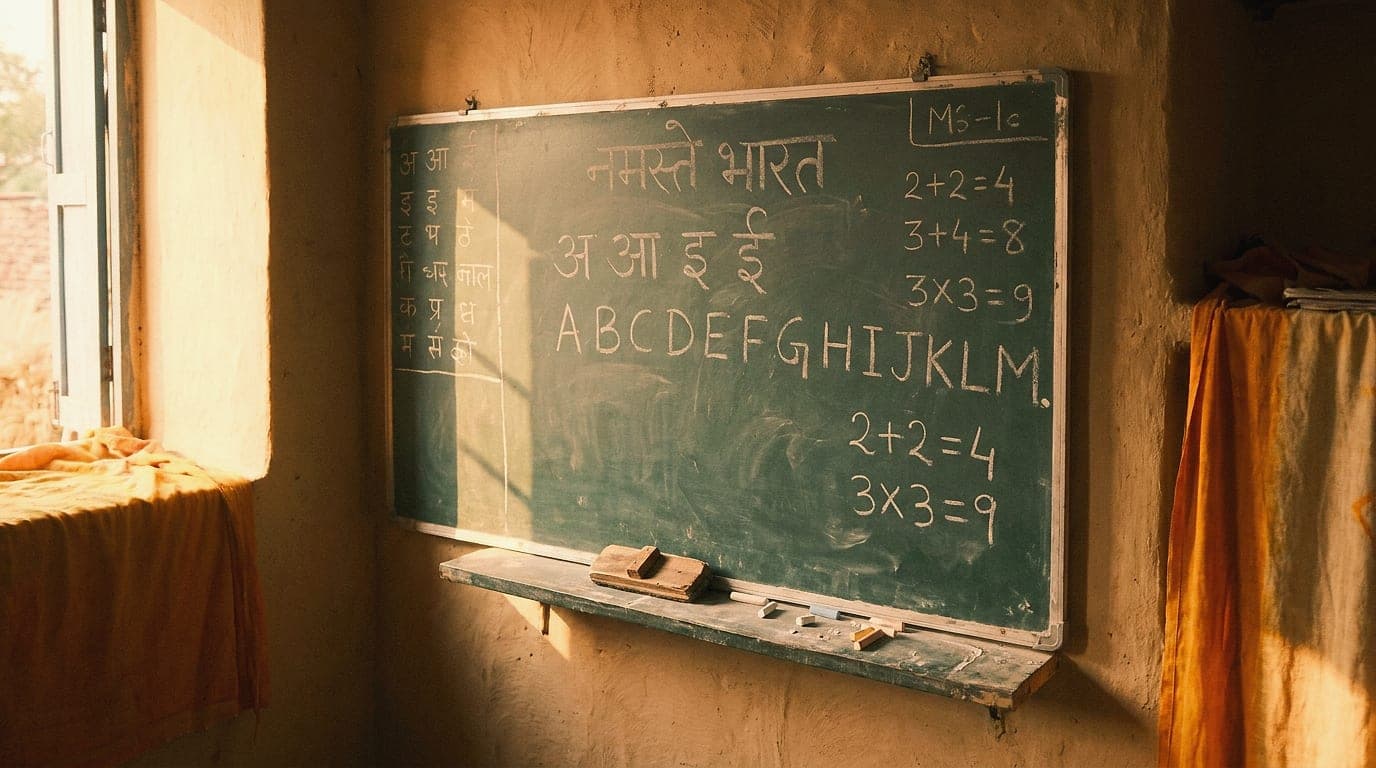
Learners are grouped by age and current ability rather than by the grade a register says they reached — across English, Hindi and Mathematics.
01
Stage 1
Age 8–10
English
- Alphabet (A–Z) identification and writing
- Names of fruits, vegetables, animals and colours
- Introduction to basic spoken English
Hindi
- स्वर और व्यंजन का ज्ञान
- बिना मात्रा वाले 2 और 3 अक्षरों के शब्द पढ़ना और लिखना
Mathematics
- Number recognition and counting from 1 to 100
- Introduction to single-digit addition
02
Stage 2
Age 10–12
English
- Phonic sounds and basic pronunciation rules
- Reading short words and simple sentences
- Daily-use conversational phrases
Hindi
- मात्राओं का संपूर्ण ज्ञान
- मात्रा वाले शब्दों और वाक्यों का अभ्यास
Mathematics
- 2-digit and 3-digit addition and subtraction
- Memorising mathematical tables from 1 to 10
03
Stage 3
Age 12–14
English
- Fluent reading of English paragraphs
- Comprehension and translation into Hindi
- Writing short essays and simple stories
Hindi
- मुश्किल और एडवांस्ड हिंदी गद्यांश को शुद्ध रूप से पढ़ना
- लेखन कौशल (writing skills)
Mathematics
- Mastery over multiplication and division
- Memorising tables from 11 to 20
- Solving basic word problems
04
Stage 4
Age 14–16
English
- Fluent spoken English communication
- Advanced grammar and formal letter writing
Hindi
- Reading and understanding complex or contemporary articles
- Articulating original thought in writing
Mathematics
- Integers and rational numbers
- Algebra and mensuration
- Powers and exponents
From classroomto career.
01
Foundational stages
Students complete the four age-based modules in English, Hindi and Mathematics.
02
Skills from day one
Spoken English and practical computer training run alongside academics throughout.
03
NIOS enrolment
Direct enrolment into 9th/10th standard through the NIOS board for a legally recognised degree.
04
Corporate readiness
Job-ready for offices, BPOs and digital call centres — a life of salary, respect and social dignity.
More than marks —real employability.
Academics alone rarely break the cycle of poverty. From the very first day, every student also builds the three skills that turn a certificate into a career.
Spoken English
A dedicated English-speaking expert removes public-speaking hesitation, refines pronunciation and builds the fluent, confident communication employers actually look for.
Practical computers
Hands-on lab training that progresses from typing and MS Paint to the full MS Office suite — Word and Excel — and professional, real-world internet use.
Corporate readiness
Communication, etiquette and digital fluency combine so that the day a student clears 12th, they are ready for offices, BPOs and digital call centres.
And for 10th and 12th pass-outs
Many underprivileged students somehow manage to complete their 10th or 12th standard, but financial constraints and a lack of modern skills leave them stuck with no job prospects.
We welcome them into the advanced spoken English and computer literacy modules to rebuild their job readiness and open a way forward.
What we needfrom partners.
To run and scale this initiative we seek financial and resource-based support in two critical domains.
A · Teachers' salary support
05
Core academic teachers
Conducting foundational and advanced classes in Hindi, English and Mathematics across all age brackets.
01
Computer teacher
Practical training in the computer lab — typing, the MS Office suite and professional internet use.
01
Spoken English expert
Removing public-speaking hesitation, refining pronunciation and driving corporate communication from day one.
B · Student resources and materials
School uniform support
Annual provision of clean, standardised uniforms, belts and footwear for every enrolled student — to cultivate parity and dignity.
Books and stationery
Curriculum textbooks, workbooks, practice notebooks, pens, pencils, drawing kits and essential teaching-learning materials.
What donorsask first.
The National Institute of Open Schooling is a recognised national board. After completing our four foundational stages, students enrol directly into 9th/10th standard through NIOS — earning a legally valid board degree at minimal cost, without the rigidity of a traditional school calendar most of our learners have already aged out of.
Underprivileged children aged 8–16 who have never attended school, have dropped out, or have very weak foundational literacy and numeracy. We also welcome 10th and 12th pass-out students into our advanced English-speaking and computer modules to rebuild their job readiness.
Instead of rigid grade levels, learners are placed into one of four stages by age and current ability (8–10, 10–12, 12–14 and 14–16). Each stage has clear English, Hindi and Mathematics goals, so a child starts exactly where they are and moves up as they master each milestone.
Spoken English and practical computer training run alongside academics from the very first day — not as an afterthought at the end. By the time a student clears 12th, fluency and digital skills are already second nature, which is what actually opens the door to a salaried, dignified job.
Two clear areas: teachers' salaries (five core academic teachers, one computer teacher and one spoken English expert) and student resources (uniforms, footwear, books, stationery and teaching-learning materials). The full breakdown is in the downloadable project proposal.
Yes. Partners can earmark a contribution toward a particular educator's salary or a specific resource such as uniforms or computer-lab equipment. Reach out through the contact page and we will share a tailored sponsorship plan and regular impact updates.
Change a life,not a statistic.
Read the full proposal, then join as a donor or a partner. Every contribution goes to a teacher's salary or a child's materials — nothing else.